CN
CN
 EN
EN
 es
es  ru
ru 



Sep 04, 2026

Determining whether the pore size of a gypsum dewatering filter cloth is suitable requires a comprehensive evaluation of multiple factors, including dewatering efficiency, gypsum cake moisture content, filtrate clarity, filter cloth clogging frequency, and overall equipment operation. Below is a systematic evaluation method and adjustment recommendations summarized by Bolian.
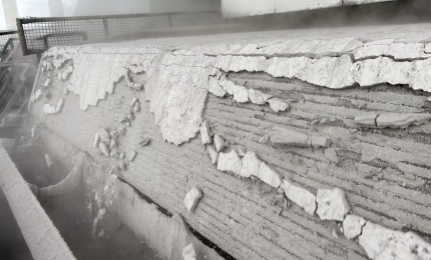
Optimal condition:The filter cake is uniformly formed, with no visible surface moisture. The moisture content is controlled within the range required by the specific process.
Pore size too large:The gypsum cake is wet and sticky, with high moisture content. Fine gypsum particles may leak through the filter cloth.
Pore size too small:The cake is excessively dry and prone to cracking. Dewatering speed may be slow, negatively affecting production capacity.
Optimal condition:The filtrate is clear, with minimal suspended solids and low gypsum loss.
Pore size too large:The filtrate appears turbid and contains a large amount of fine gypsum particles, resulting in material loss.
Pore size too small:The filtrate is clear, but filtration resistance is high, increasing the risk of clogging.
Optimal condition:At normal vacuum or pressure levels, the dewatering cycle is stable and production capacity meets requirements.
Pore size too large:Dewatering is fast, but the gypsum cake retains high moisture. Vacuum levels may be relatively low.
Pore size too small:Dewatering is slow, with vacuum pumps operating under high load for extended periods, leading to increased energy consumption.
Coordinated Optimization: Filter cloth pore size should be optimized in coordination with vacuum level, slurry concentration, gypsum crystal quality, and additive dosage.
Technical Support: Provide operating condition data (particle size distribution, pH value, temperature, etc.) to professional filter cloth manufacturers for accurate model selection.
Regular Evaluation: Reassess dewatering performance regularly or whenever a new batch of filter cloth is installed. Record key data for continuous optimization.
Online Monitoring: If conditions permit, install online moisture analyzers or turbidity meters to enable real-time monitoring and rapid response.
The ultimate goal is to ensure gypsum quality while achieving low energy consumption and long service life of gypsum dewatering filter cloths under stable operating conditions.